
285 Hz frequency benefits are mostly claims and not findings. Wellness sites call it the “tissue healing frequency” and say it repairs wounds, cells and your energy field. I found no human study that tests those claims. The real science is about music in general.
285 Hz (also written 285hz or 285 hertz) is a pitch of 285 cycles per second. Music can ease anxiety, stress and pain a little, and your brain tracks tones near 285 Hz. Neither fact shows that 285 Hz itself heals anything. I last checked PubMed on 3 October 2026.
Jump to: What it is | 12 claims graded | Research | Tissue healing | Music research | Other frequencies | Chakra | Safe listening | FAQ
What is 285 Hz?
285 Hz means 285 vibrations per second. It’s a low-mid pitch near the D above middle C. In standard A = 440 tuning it falls between C#4 (277.2 Hz) and D4 (293.7 Hz), about 52 cents flat of D4. That’s almost exactly a quarter-tone between two notes. A pure 285 Hz tone sounds like a plain, low hum.
The number comes from the modern nine-tone “Solfeggio” wellness chart. The solfege syllables (do, re, mi) go back to Guido of Arezzo in the 11th century. The frequencies don’t. History write-ups credit Joseph Puleo with six of them in the 1970s through numerology, and Leonard Horowitz with adding 174 Hz, 285 Hz and 963 Hz in 1999. I found no medieval source that lists them.
A “285 Hz track” can be a pure tone, a drone or music. Those aren’t the same exposure, and no study has tested them against each other.
285 Hz frequency benefits: 12 claims vs evidence
These are the 285 Hz benefits people claim most, each graded against the evidence.
| Claim | What the evidence shows | Verdict |
|---|---|---|
| Heals tissue or wounds | No human trial. Even ultrasound, which is far above hearing range, failed to speed fracture healing in the best trials | Not supported |
| Regenerates cells or organs | No human study | Not supported |
| Repairs DNA or slows aging | No human study | Not supported |
| Relieves pain | No 285 Hz trial. Music in general may ease pain a little | Not supported |
| Reduces anxiety or stress | Music does, in a review of 51 trials. 285 Hz wasn’t isolated | Indirect only |
| Improves sleep | Recorded music may improve self-rated sleep quality. 285 Hz wasn’t tested | Indirect only |
| Boosts immunity or helps the lungs | No study found | Not supported |
| Changes brain activity | The brain tracks tones from 240 to 285 Hz. That’s hearing and not healing | Hearing only |
| Works on cancer cells | A 2026 lab study used 285 Hz electromagnetic fields, not sound, on cells in dishes | Not supported |
| Repairs your aura or energy field | Nothing to measure | Belief |
| Opens a chakra | Charts disagree and no study tests it | Belief |
| Is safe to play | Depends on volume and time, not on the pitch | True, with limits |
What does research say about 285 Hz itself?
The only human research I found that uses 285 Hz is hearing science. In 2017 Prendergast and colleagues played 126 young adults pure tones from 240 to 285 Hz at 80 dB and recorded their brainstem responses. It showed the brain follows these pitches. It wasn’t a therapy study. PubMed
A PubMed search for “285 Hz” and “Solfeggio frequencies” returned 14 papers. None tests 285 Hz sound as a treatment in people. They cover hearing tests, sensors, snore analysis, fish and ultrasound pulse rates.
The newest is from September 2026. Researchers treated breast cancer cells in dishes with low-intensity electromagnetic fields at 396, 285 and 528 Hz, together with a drug. Electromagnetic fields aren’t sound, cells in dishes aren’t people, and the authors call for more validation. It says nothing about listening to 285 Hz. PubMed
A 2023 study found that Solfeggio-frequency music reversed stress effects in zebrafish. That’s fish, and it doesn’t single out 285 Hz. PubMed
Does any sound heal tissue or wounds?
People who search “tissue healing frequency” or “wound healing frequency” often mix up two things. Therapeutic ultrasound is sound above 20,000 Hz, far beyond anything you can hear. A 2017 BMJ review of 26 trials tested low-intensity pulsed ultrasound for broken bones. In the most trustworthy trials it did not improve outcomes patients care about, and it probably had no effect on x-ray bone healing. PubMed
So a claim that a 285 Hz audio track speeds up healing needs its own evidence. It doesn’t have any yet. If you have a wound or injury, see a clinician.
What music research does show
A 2025 meta-analysis of 51 trials found that music therapy lowers anxiety. The overall effect was medium (g = 0.36). Self-reported anxiety dropped more (g = 0.41), while physiological measures changed little and not significantly (g = 0.15). PubMed
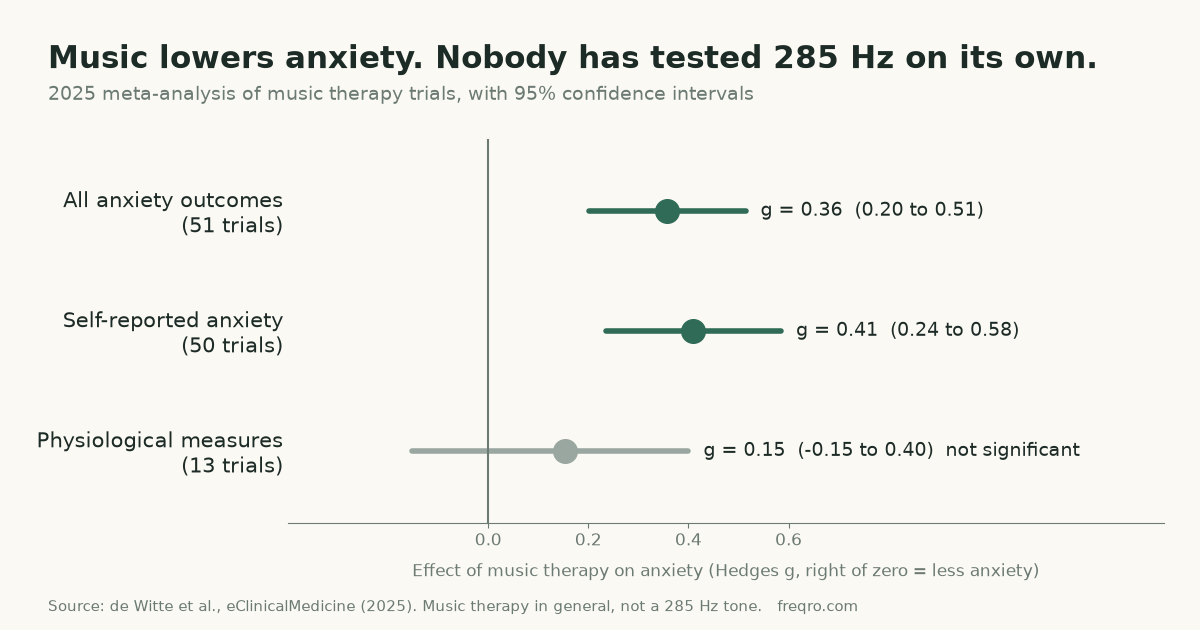
NIH’s NCCIH says music may help with anxiety, stress, some pain and subjective sleep quality, and that much of the research is still preliminary.
So a calm 285 Hz track may help you relax. The music, the quiet room and your expectation may be doing the work.
Do specific frequencies matter?
Small studies compare tunings, but not 285 Hz. In a 42-person dental trial, anxiety fell with both 432 Hz and 440 Hz music, and cortisol was lower in the 432 Hz group. PubMed A 2026 trial of 162 students compared 528 Hz music, 432 Hz music and silence. Saliva markers differed, and a thinking test didn’t. PubMed
Those results don’t carry over to 285 Hz. Tracks that stack 285 Hz with 528 or 852 Hz are layered music, so no effect can be credited to one pitch. For the details, see our 432 Hz, 528 Hz and 128 Hz articles.
Which chakra is 285 Hz?
Charts disagree. Our healing frequencies list pairs 285 Hz with no usual chakra and describes it as renewal and feeling restored. Some sellers call it a heart chakra tone or a fix for “holes in the aura”. That’s belief and personal experience. No study can test an aura.
Is 285 Hz safe? How to listen
The pitch isn’t the risk. Volume and time are. The WHO says you can safely listen at 80 dB for up to 40 hours a week, and at 90 dB the safe time drops to about 4 hours. Keep your device at 60% volume or lower. WHO safe listening
Nobody has tested how long to listen, so start short and stop if you feel dizzy or hear ringing. 285 Hz tuning fork benefits are untested too, because I found no trial of one. Keep the volume moderate with headphones you can wear comfortably.
If pain, anxiety, poor sleep, ringing in the ears or hearing changes keep coming back, see a clinician. 285 Hz can sit alongside care. It doesn’t replace it.
285 Hz FAQ
What does 285 Hz do?
Nothing proven beyond being a sound you can hear. The brain tracks tones near 285 Hz, and calm music can help some people relax. No study shows 285 Hz heals tissue, relieves pain or treats a condition.
What are the benefits of 285 Hz?
The 285hz benefits sold online, such as tissue repair, pain relief and better sleep, have no direct evidence. Music in general helps anxiety and stress a little, but 285 Hz hasn’t been tested on its own.
What is 285 Hz good for?
Mainly as a sound some people use to relax. If you find a 285 Hz track calming, that experience can be real. It doesn’t prove the pitch is the cause.
Does 285 Hz heal tissue or wounds?
No study shows that. A 2017 BMJ review found that ultrasound, which is far above hearing range, didn’t help fresh fractures heal in the best trials. See a clinician for wounds and injuries.
Does 285 Hz repair cells or DNA?
No human study shows it. A 2026 lab study used 285 Hz electromagnetic fields, not sound, on cancer cells in dishes. It says nothing about listening to 285 Hz.
Can 285 Hz help with pain or sleep?
Not shown. Music in general may ease pain a little and may improve self-rated sleep quality, but 285 Hz wasn’t isolated in any trial I found.
What chakra is 285 Hz?
Charts disagree. Our healing frequencies list pairs it with no usual chakra, and some sellers say heart chakra. No study tests a chakra.
Is 285 Hz a Solfeggio frequency?
Yes, on the modern nine-tone chart. That chart dates to the 1970s and 1999, not the Middle Ages, and I found no medieval source for it.
What note is 285 Hz, and what can I listen to at 285 Hz?
It sits between C#4 and D4, about 52 cents flat of D4. You can play a pure tone from a tone generator, a drone or a track labelled 285 Hz. They’re different exposures.
Is 285 Hz safe? How long can you listen?
The risk is volume and time, not the pitch. The WHO says 80 dB is safe for up to 40 hours a week and 90 dB for about 4. Nobody has tested a dose, so start short.
What is the healthiest Hz to listen to?
No frequency is proven healthiest. For your hearing, what matters is moderate volume and regular breaks.
Sources and references (12)
Every study figure on this page traces to one of these.
Evidence
- de Witte M, et al. (2025). Music therapy for the treatment of anxiety: a systematic review with multilevel meta-analyses. eClinicalMedicine 84:103293.
- National Center for Complementary and Integrative Health. Music and Health: What You Need To Know.
- Prendergast G, et al. (2017). Effects of noise exposure on young adults with normal audiograms I: Electrophysiology. Hear Res 344:68-81.
- Haroutunian G, et al. (2026). Triple-Frequency Electromagnetic Stimulation Combined with Fingolimod Reduces Breast Cancer Cell Proliferation and Metastasis-Associated Extracellular Vesicle Protein Levels. Pharmaceuticals 19(9).
- Dos Santos AC, et al. (2023). Solfeggio-frequency music exposure reverses cognitive and endocrine deficits evoked by a 24-h light exposure in adult zebrafish. Behav Brain Res 450:114461.
- Schandelmaier S, et al. (2017). Low intensity pulsed ultrasound for bone healing: systematic review of randomized controlled trials. BMJ 356:j656.
- Aravena PC, et al. (2020). Effect of music at 432 Hz and 440 Hz on dental anxiety and salivary cortisol levels in patients undergoing tooth extraction. J Appl Oral Sci 28:e20190601.
- Bozok UG, et al. (2026). Acute Music-Frequency Exposure Modulates Salivary Stress and Neurotrophic Markers in Young Adults. Brain Behav 16(5):e71452.