
Kundalini awakening symptoms are bodily and mental experiences that people link to a rising energy. Examples are tingling, heat, shaking, strong emotion and a changed sense of self. Studies describe these experiences well. They haven’t found an energy behind them, and most symptoms also have ordinary medical causes.
I read the key studies. They cover 80 tantric yoga meditators, 152 people with spontaneous awakenings, 60 meditators who struggled and a review of 83 meditation studies. Most people in the awakening samples rated the experience positive. In the group studied for difficulties, 17% needed hospital care.
This page lists 20 kundalini symptoms and signs of awakening, what the research found for each, what else can cause them and when to see a doctor first.
Jump to: What it is | 20 signs | What it feels like | How long | How to know | Side effects | Something else? | Get help | Dark kundalini | Stages and ascension | Kundalini yoga | FAQ
What is a kundalini awakening?
In tantric and hatha yoga, kundalini is described as a coiled energy at the base of the spine. When it awakens, it is said to rise through the chakras toward the crown of the head. Our chakra frequency chart shows how the chakras are usually mapped.
Science hasn’t found that energy, or the chakras and channels it travels through. What researchers can study is what people report. So “kundalini awakening” works as a label for a cluster of bodily, emotional and perceptual experiences.
Some awakenings follow practice such as meditation, breathwork or yoga. Others are called sudden, spontaneous or accidental. In a survey of 152 people with spontaneous awakenings, people named these triggers:
- 52% named psychological turmoil or trauma
- 47% named meditation
- 32% named spiritual reading
- 22% named contact with nature
- 22% named past psychedelic use
- 18% named yoga
Some people call an awakening “premature” when it feels too early or too much. That’s a belief about readiness. No test measures it.
Don’t mix it up with kundalini yoga. Kundalini yoga is a practice and an awakening is an experience. More on that below.
Kundalini awakening symptoms: 20 signs
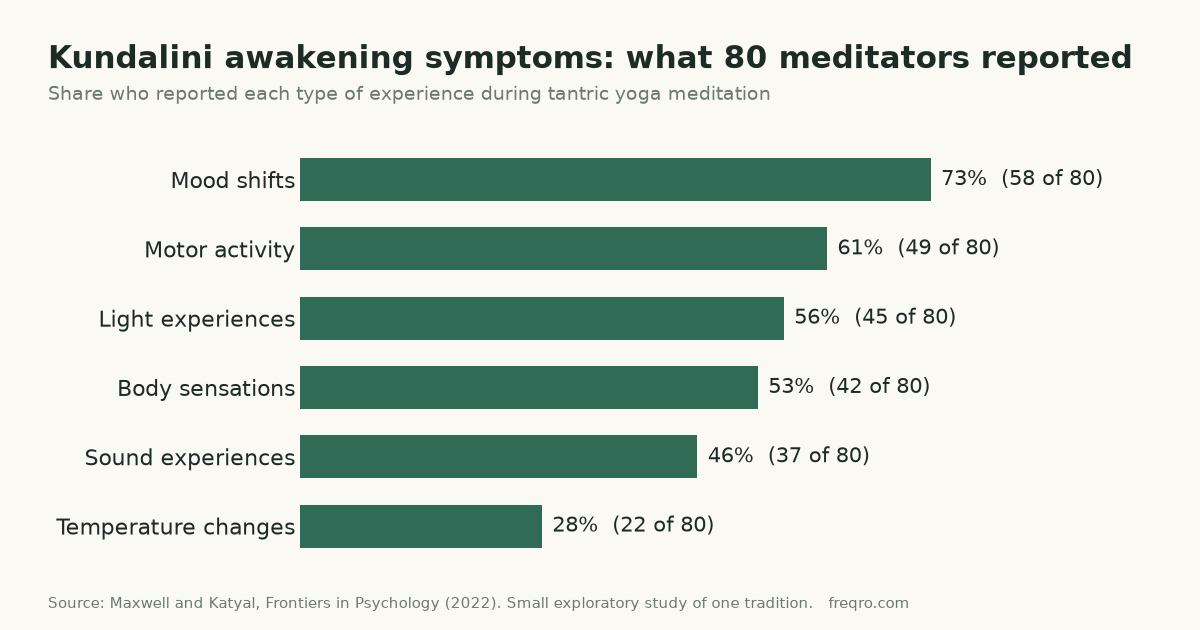
Two small studies give the best numbers. Maxwell and Katyal asked 80 meditators from a tantric yoga tradition about experiences during practice. Corneille and Luke surveyed 152 people with spontaneous spiritual awakenings, and about 40% of those were kundalini-type.
Both samples are small and self-selected. No validated checklist can prove that someone is “definitely” having a kundalini awakening. Treat the tables below as a kundalini symptoms list of what people report. They aren’t a test.
Body and energy signs
| Sign | What people describe | What the research found |
|---|---|---|
| 1. Tingling or vibrations | Buzzing, waves, “electric” currents | Of 42 meditators who reported body sensations, 33% said vibrating, 29% energy, 24% tingling and 21% pressure. Meditators in another study described electricity-like currents |
| 2. Energy rising up the spine | A current moving from the base of the spine toward the head | 31% of those 42 (13 people) described rising sensations in the spine or back. The “rising” motif is what people most tie to kundalini |
| 3. Heat or burning sensations | Warmth, burning along the spine or skin, hot or cold patches | 28% of the 80 meditators (22) reported temperature changes. Traditional texts stress heat more than modern studies do |
| 4. Hot flashes and sweating | Sudden heat and sweat, often at night | I found no study that measures it in kundalini reports. It’s also a classic menopause and panic symptom |
| 5. Pressure in the head, forehead or crown | A tight band, pulsing at the brow or top of the head | Reported near the spine, crown, forehead and chest. People read these spots through chakras, which aren’t established anatomical structures |
| 6. Dizziness or a spinning feeling | Floating, spinning, feeling off balance | Common in online lists. I found no study that measures it, and dizziness is also a panic symptom |
| 7. Shaking, twitching or involuntary movements (kriyas) | Trembling, jerks, spontaneous stretches, postures or hand shapes | 61% of the 80 meditators (49) reported motor experiences. Of those, 67% had abrupt movements, 55% positioning movements, 51% breathing changes and 47% vocalizations. People with kundalini awakenings reported more involuntary positioning and physical symptoms than other spontaneous awakeners (p<0.001) |
| 8. Breathing changes and a racing heart | Deep, slow, held or fast breath, a pounding heart | Breathing changes were common among those with motor experiences. These signs aren’t specific to kundalini |
| 9. Aches, pain or muscle tension | Back, neck or shoulder pain | One study linked energy surges to a release of pressure and tension. I found no study that measures pain as a kundalini symptom |
Perception signs
| Sign | What people describe | What the research found |
|---|---|---|
| 10. Inner lights, visions or vivid imagery | Flashes, brightness, imagery with eyes closed | 56% of the 80 meditators (45) reported light experiences |
| 11. Ringing, humming or heightened senses | A hum or roar, and light, sound or touch feeling stronger | 46% (37) reported sound experiences |
Emotional signs
| Sign | What people describe | What the research found |
|---|---|---|
| 12. Bliss, love and awe | Joy, deep peace, gratitude | Mood shifts were the most common experience: 73% of the 80 meditators (58). In spontaneous awakenings the top-scoring items were interest in seeing truth, gratitude and deep love |
| 13. Fear, panic or mood swings | Dread, grief, volatility | Fear scored among the lowest items in the spontaneous awakening survey. In a review of meditation studies, anxiety was the most commonly reported problem |
| 14. Sudden crying, laughing or emotional release | Waves of tears or laughter | No study measures this on its own. It falls under mood shifts |
Mind and self signs
| Sign | What people describe | What the research found |
|---|---|---|
| 15. Oneness or a loosened sense of self | Softer body boundaries, timelessness, merging | 63% of spontaneous awakeners met the criteria for a complete mystical experience |
| 16. Detachment or feeling unreal | Feeling cut off from your body or thoughts | It can feel pleasant in one setting and frightening in another. It’s also a panic symptom |
| 17. Brain fog or racing thoughts | Poor focus, confusion, intrusive thoughts | Cognitive problems showed up in 14 of 55 meditation studies that reported harms. Racing thoughts with little sleep can also signal mania |
| 18. Sleep changes and vivid dreams | Less sleep, vivid dreams, buzzing at night | Reduced sleep is common in accounts. Sleep loss can itself intensify odd perceptions, which muddies the picture |
Pelvic signs and lasting changes
| Sign | What people describe | What the research found |
|---|---|---|
| 19. Pelvic or sexual sensations | Pelvic energy, changed libido, spontaneous arousal | Described in awakening writing and studied less than body, perception and emotion |
| 20. Changed values and priorities | More compassion, creativity, spiritual interest | 98% of spontaneous awakeners rated the long-term effects positive. That’s a self-selected sample recalling the past |
What does a kundalini awakening feel like?
The research points to one recurring pattern in kundalini energy symptoms. It starts with odd body sensations such as vibration, tingling, pressure or a feeling of upward movement. Spontaneous movement or breathing changes follow. Then come intense emotion or bliss, altered perception or self-boundaries, and a sense of deep meaning.
The rising-energy-in-the-spine motif is what people most tie to kundalini rising symptoms. Mystical experiences without strong body phenomena are usually just called spiritual awakenings. Even that split is descriptive and not a diagnosis.
In the survey of spontaneous awakenings, kundalini awakeners reported more physical symptoms and more involuntary positioning than other spontaneous awakeners (p<0.001). They were also more likely to have practiced yoga before (p=0.003). Negative experiences didn’t differ between the two groups.
Your own experience may not match any list. Most people don’t have all 20 signs, and the studies didn’t test for a fixed order.
How long do kundalini symptoms last?
It varies a lot. In the survey of 152 spontaneous awakenings, people described how long the peak experience lasted:
| Length of the peak experience | Share of people |
|---|---|
| Minutes | 21.1% |
| Hours | 10.5% |
| Days | 7.9% |
| Weeks | 9.2% |
| Months | 14.5% |
| Years | 7.9% |
| Still ongoing | 28.9% |
In a separate study of meditators with difficulties, the median length of symptoms was 1 to 3 years. Those people were chosen for having problems, so don’t read that as typical.
How do you know if your kundalini is awakened?
You can’t know for sure. No scientifically validated test or symptom combination proves a kundalini awakening. The best you can do is compare your experience with the pattern above.
If something strange is happening, do these in order:
- Get any physical symptom checked first. Tingling, shaking, a racing heart and dizziness all have medical causes.
- Write down when it happens: during practice, at night, after stress or after skipping meals.
- Track your sleep. Sleep loss makes strange experiences stronger.
- Cut back any sudden jump in practice time, fasting or retreat intensity.
- Tell someone you trust. A clinician who respects spiritual experience is ideal.
Kundalini awakening side effects: how often is it positive or hard?
Both. The same experience can feel meaningful to one person and frightening to another. No study tells you how common kundalini side effects are, because nobody has sampled the general population. These studies give the closest picture:
| Study | People | What it found | Caveat |
|---|---|---|---|
| Corneille and Luke 2021 | 152 spontaneous awakenings | 91% rated short-term effects positive and 9% negative. 98% rated long-term effects positive | Recruited through spiritual-interest Facebook ads. People recalled the past |
| Lindahl 2017 | 60 Western Buddhist meditators, studied for meditation-related difficulties | 59 types of experience in 7 areas. 88% had effects in daily life and 73% had moderate to severe impairment in at least one area. 17% reported suicidality and 17% needed hospital care | Chosen for having difficulties, so not typical |
| Farias 2020 | 83 studies, 6,703 meditators | 8.3% had an adverse event overall (3.7% in experiments and 33.2% in observational studies) | About meditation in general and not kundalini |
| Charan 2022 | 5 people with psychosis after meditation | Risks included a sudden jump in practice, 7 to 12 hours a day, little sleep, fasting, isolation and psychiatric history. All improved within 1 to 4 weeks after stopping meditation and starting treatment | A tiny case series |
| Sharma 2022 | 1 case report | Described a kundalini awakening that presented as psychosis | One case |
What tips an experience toward helpful or harmful? Interpretation, intensity of practice, sleep, fasting, existing vulnerability, social context and access to knowledgeable support all seem to matter. That’s the pattern across the meditation research and not a prediction for you.
Could it be something else?
Probably, at least in part. Many items on the symptom list have a common non-spiritual cause. A spiritual reading and a medical check don’t cancel each other. You can have both.
| Symptom | Common non-spiritual causes | Source |
|---|---|---|
| Tingling or pins and needles | Pressure on a nerve, diabetes, breathing too fast, some medicines, multiple sclerosis. The NHS says to see a GP if it’s constant or keeps coming back | NHS pins and needles |
| Racing heart, sweating, trembling, dizziness, feeling unreal | Panic attack. Attacks usually last 5 to 20 minutes | NHS panic disorder |
| Hot flashes, night sweats, palpitations, brain fog, poor sleep | Menopause | NHS menopause |
| Jerking, stiffness, odd sensations, sudden fear, loss of awareness | Seizure. Call emergency services for a first seizure | NHS epilepsy |
| Little need for sleep, racing thoughts, lots of energy, overconfidence | Mania, which can also bring hallucinations or delusions | NHS bipolar disorder |
| Seeing or hearing things, strong false beliefs, fast confused thinking | Psychosis. Causes include stress, drugs, medicines and head injury | NHS psychosis |
“Kundalini syndrome” isn’t a recognized medical diagnosis. Researchers do recognize that spiritual experiences shouldn’t automatically be treated as mental illness. The DSM-IV includes a “religious or spiritual problem” category for exactly that reason. PubMed What matters is distress, how you’re functioning, whether you can tell inner experience from outer reality, how long it lasts and whether a medical cause is behind it.
When to get medical help
Don’t assume it’s kundalini if any of these happen. Get medical or mental-health help promptly, even if the experience also feels spiritual.
- You lose consciousness or have seizure-like activity.
- You have severe or lasting chest pain, trouble breathing or another urgent physical symptom.
- You can’t sleep for several nights, especially with rising energy or agitation.
- You’re fasting hard or not drinking enough, and you feel unwell.
- Your behavior is escalating, risky or disorganized.
- You have thoughts of ending your life or harming someone.
- You hear commanding voices, feel paranoid or can’t tell inner experience from the outside world.
- You can’t look after your basic needs or stay safe.
If you’re in danger now, call your local emergency number. In the US you can call or text 988. In the UK and Ireland you can call Samaritans on 116 123. 988 Lifeline
Dark kundalini awakening symptoms
“Dark kundalini awakening” and “kundalini crisis” aren’t clinical terms. People use them for a frightening version of the experience. It can bring fear, burning sensations, no sleep, a feeling of detachment or a mind that won’t slow down.
The research doesn’t use those labels, but it describes the same ground. In the study of meditators with difficulties, people reported effects in the cognitive, perceptual, emotional, bodily, motivational, self-related and social areas. Some described electricity-like surges they couldn’t control, along with involuntary movements. In that group, 73% had moderate to severe impairment in at least one area.
“Kundalini cleansing” and “kundalini blockage” are belief-based ideas. No study tests them. If the symptoms are distressing, treat them like any other distressing symptoms. The red flags above apply.
Stages, ascension and other terms
What are the 7 stages of kundalini awakening? The usual lists map each stage to a chakra, from root to crown. They come from modern spiritual writing. I found no study that shows a fixed sequence, and the awakening studies didn’t test for one.
“Ascension symptoms”, “kundalini activation symptoms” and “kundalini arousal symptoms” are modern names for a similar mix of signs. I found no research that uses those terms. The same advice applies. Check for medical causes first.
“Shakti awakening” and “kundalini sickness” are other names for the same family of experiences. The research can describe what people feel. It can’t confirm the energy behind the names.
Kundalini yoga vs kundalini awakening
Kundalini yoga combines breathwork, meditation, movement and chanting. A 2026 systematic review looked at 15 randomized trials with about 1,370 people, published between 2015 and 2024. It reported better memory, executive function, anxiety, PTSD and OCD symptoms, sleep and emotional regulation, plus modest gains in fatigue and blood pressure. No serious adverse events were reported, and the authors called for larger trials. PubMed
Those trials tested a practice. They didn’t test whether it causes a kundalini awakening, and they don’t tell you what awakening symptoms mean.
If you practice and you notice strong effects, keep the changes gradual, protect your sleep and eat and drink normally.
Kundalini awakening FAQ
What are the symptoms of kundalini awakening?
People report tingling, vibrations, heat, shaking, breathing changes, inner lights, strong emotion, a loosened sense of self and sleep changes. Studies describe these experiences but can’t confirm an energy behind them, and most also have medical causes.
What are the signs of kundalini awakening?
The most reported signs are body sensations such as tingling or energy rising up the spine, spontaneous movement, intense emotion and a changed sense of self. No validated checklist proves a kundalini awakening.
What are the physical symptoms of kundalini awakening?
Tingling, vibration, pressure, heat, shaking, breathing changes and a racing heart. In 80 tantric yoga meditators, 53% reported body sensations, 61% motor experiences and 28% temperature changes. Each of these also has medical causes.
What does a kundalini awakening feel like?
Often like waves, vibrations or a current moving through the body, sometimes upward along the spine, with strong emotion and a changed sense of self. It can feel blissful or frightening, and different people read the same experience differently.
How do you know if your kundalini is awakened?
You can’t know for sure because no test proves it. Compare your experience with the pattern in the research, get physical symptoms checked first, track your sleep and talk to someone you trust.
What are the side effects of kundalini activation?
Reported problems include anxiety, trouble sleeping, detachment, confusion and, in case reports, psychosis. In a review of 83 meditation studies, 8.3% reported an adverse event. Get help promptly if you can’t sleep for days, feel unsafe or lose touch with reality.
What are dark kundalini awakening symptoms?
It’s a non-clinical term for a frightening awakening: fear, burning sensations, no sleep, detachment or a racing mind. Treat these like any distressing symptoms and get checked for medical and mental-health causes.
Is kundalini awakening dangerous?
It can be hard. In self-selected surveys most people rated spontaneous awakenings positive (91% short term). In a study of meditators with difficulties, 73% had moderate to severe impairment and 17% needed hospital care. Know the red flags and get help early.
What is kundalini syndrome?
It isn’t a recognized medical diagnosis. People use the term for distressing symptoms linked to a kundalini awakening. Clinicians look at distress, daily function, reality testing and medical causes.
How long do kundalini symptoms last?
It varies. In 152 spontaneous awakenings, the peak experience lasted minutes for 21.1%, months for 14.5% and years for 7.9%, and 28.9% said it was ongoing.
Can kundalini cause a burning sensation?
Heat and burning along the spine or skin are commonly described, and 28% of 80 meditators reported temperature changes. Burning can also have medical causes. The NHS advises seeing a GP when tingling is constant or keeps coming back, so do the same for burning.
What are kundalini awakening symptoms in women?
I found no study that compares symptoms by sex. Hot flashes, night sweats, palpitations and brain fog are common menopause symptoms, so get them checked before linking them to kundalini.
What are the 7 stages of kundalini awakening?
Online lists map seven stages to the seven chakras. They come from modern spiritual writing, and I found no study that shows a fixed sequence.
Are ascension symptoms the same as kundalini symptoms?
They overlap. Ascension symptoms is a modern term for a similar mix of body, emotional and sleep changes. No research uses it, and the same medical checks apply.
Can a kundalini awakening happen suddenly or by accident?
People report sudden or spontaneous awakenings. In a survey of 152, the named triggers were psychological turmoil or trauma (52%), meditation (47%), spiritual reading (32%), nature (22%), past psychedelic use (22%) and yoga (18%).
When should I see a doctor?
Get help promptly if you lose consciousness, have chest pain or trouble breathing, can’t sleep for several nights, feel paranoid or hear commanding voices, or have thoughts of harming yourself or others. In an emergency call your local emergency number.
Is kundalini yoga the same as kundalini awakening?
No. Kundalini yoga is a practice of breathwork, meditation, movement and chanting. An awakening is an experience. A 2026 review of 15 trials found benefits for several health outcomes and no serious adverse events, but it didn’t study awakenings.
Sources and references (16)
Every study figure on this page traces to one of these. The medical overlap table uses NHS pages.
Kundalini and meditation research
- Maxwell RW, Katyal S. (2022). Characteristics of Kundalini-Related Sensory, Motor, and Affective Experiences During Tantric Yoga Meditation. Front Psychol 13:863091.
- Corneille JS, Luke D. (2021). Spontaneous Spiritual Awakenings: Phenomenology, Altered States, Individual Differences, and Well-Being. Front Psychol 12:720579.
- Lindahl JR, et al. (2017). The varieties of contemplative experience: A mixed-methods study of meditation-related challenges in Western Buddhists. PLoS One 12(5):e0176239.
- Farias M, et al. (2020). Adverse events in meditation practices and meditation-based therapies: a systematic review. Acta Psychiatr Scand 142(5):374-393.
- Charan D, et al. (2022). Meditation Practices and the Onset of Psychosis: A Case Series and Analysis of Possible Risk Factors. Indian J Psychol Med 45(1):80-84.
- Sharma M, Dhankar M, Kumar D. (2022). Awakening of Kundalini Chakras Presenting as Psychosis: A Case Report. Indian J Psychol Med 44(5):526-528.
Psychiatry, medical overlap and support
- Turner RP, Lukoff D, Barnhouse RT, Lu FG. (1995). Religious or spiritual problem. A culturally sensitive diagnostic category in the DSM-IV. J Nerv Ment Dis 183(7):435-44.
- NHS. Pins and needles.
- NHS. Panic disorder.
- NHS. Menopause: symptoms.
- NHS. Epilepsy: symptoms.
- NHS. Bipolar disorder: symptoms.
- NHS. Psychosis.
- 988 Suicide and Crisis Lifeline (US).